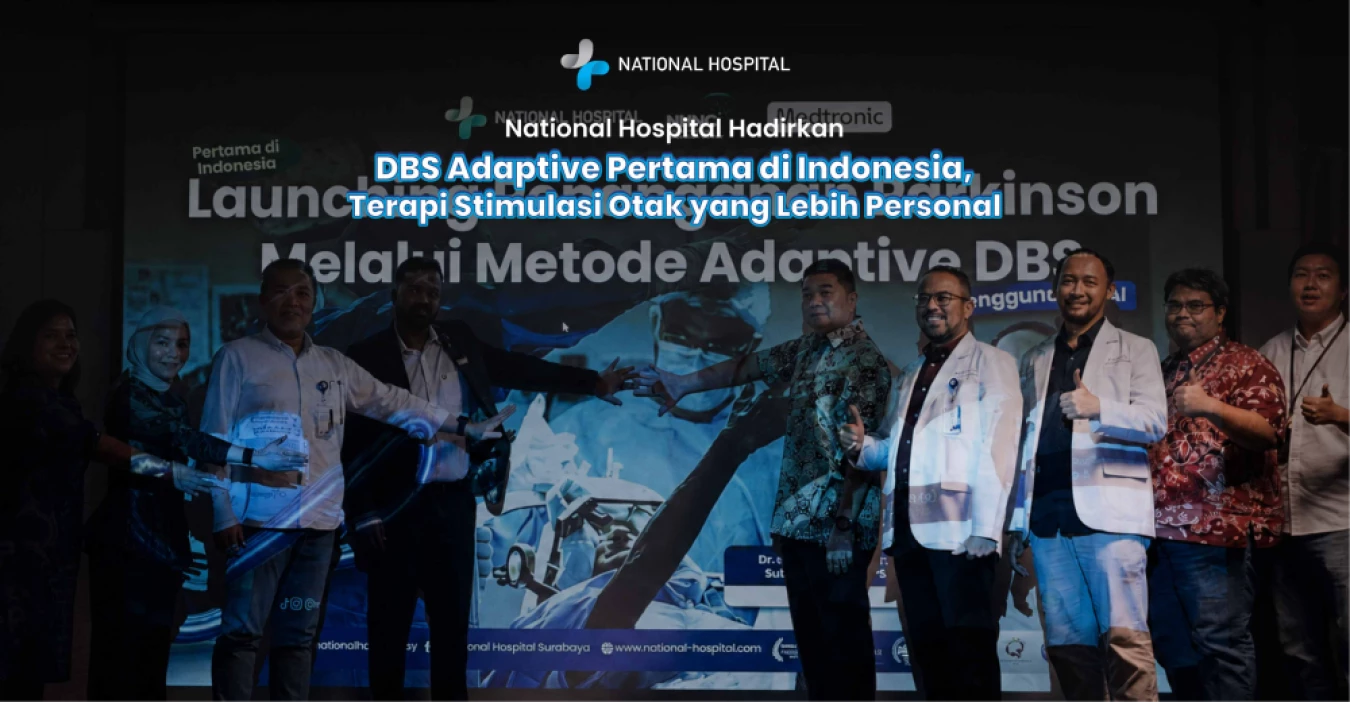
Movement disorders caused by neurological diseases, such as tremors, muscle stiffness (rigidity), and slowed movements (bradykinesia), can affect a person's ability to carry out daily activities. For certain patients, one of the therapies to help control these symptoms is Deep Brain Stimulation (DBS), which involves delivering electrical stimulation to specific areas of the brain.
Along with the advancement of medical technology, DBS therapy continues to undergo innovation. National Hospital, through the National Hospital Neuroscience Center (NHNC), in collaboration with Medtronic, now introduces the first Adaptive Deep Brain Stimulation (Adaptive DBS/aDBS) technology in Indonesia, a latest-generation technology that offers a more personalized and responsive therapeutic approach according to the patient's condition.
Unlike conventional DBS, which provides stimulation based on parameters programmed by doctors, Adaptive DBS uses closed-loop stimulation technology that allows the device to detect the patient's brain electrical activity in real-time through BrainSense technology. Based on this information, the system can automatically adjust stimulation intensity according to the patient's needs while remaining within the parameter limits set by the doctor.
This approach was developed because each patient has different symptom patterns, which may even change throughout the day. With the ability to adjust therapy in real-time, Adaptive DBS is expected to provide more optimal symptom control while reducing unnecessary stimulation. This has the potential to improve patient comfort in carrying out daily activities and support therapy that is more tailored to each individual's needs.
Adaptive DBS technology works based on the principle of closed-loop stimulation, where electrodes implanted in specific areas of the brain not only function to deliver electrical stimulation but also record brain electrical activity associated with disease symptoms. These signals are then analyzed by the system to determine whether the patient requires higher or lower stimulation. Based on the analysis results, the device automatically adjusts stimulation in real-time according to the settings programmed by the doctor.
Compared to Continuous DBS (cDBS), Adaptive DBS offers a more dynamic therapy approach with the potential to improve the control of motor symptoms, such as tremors, rigidity, and bradykinesia. In addition, the ability to adjust stimulation according to the patient's brain activity also has the potential to reduce unnecessary stimulation, helping to minimize side effects caused by excessive stimulation while improving device battery efficiency.
Although the device is capable of automatically adjusting stimulation, the doctor's role remains a key part of the overall therapy. Doctors determine the therapy targets, stimulation areas, safety parameters, and stimulation adjustment limits, while the system performs automatic adaptation within the predefined range. Therefore, this technology does not replace the role of doctors, but rather serves as a tool that supports the delivery of more precise therapy.
Through the launch of the first Adaptive DBS in Indonesia, National Hospital, together with the National Hospital Neuroscience Center and Medtronic, reaffirms its commitment to providing neurological service innovations based on the latest technology. The introduction of this technology is expected to expand access for Indonesian patients to modern neuromodulation therapy, while opening a new era in the management of movement disorders that is more personalized, precise, and focused on improving patients' quality of life.




 info@national-hospital.com
 628131000517
 Suggestion
 Login
Login
.png)
