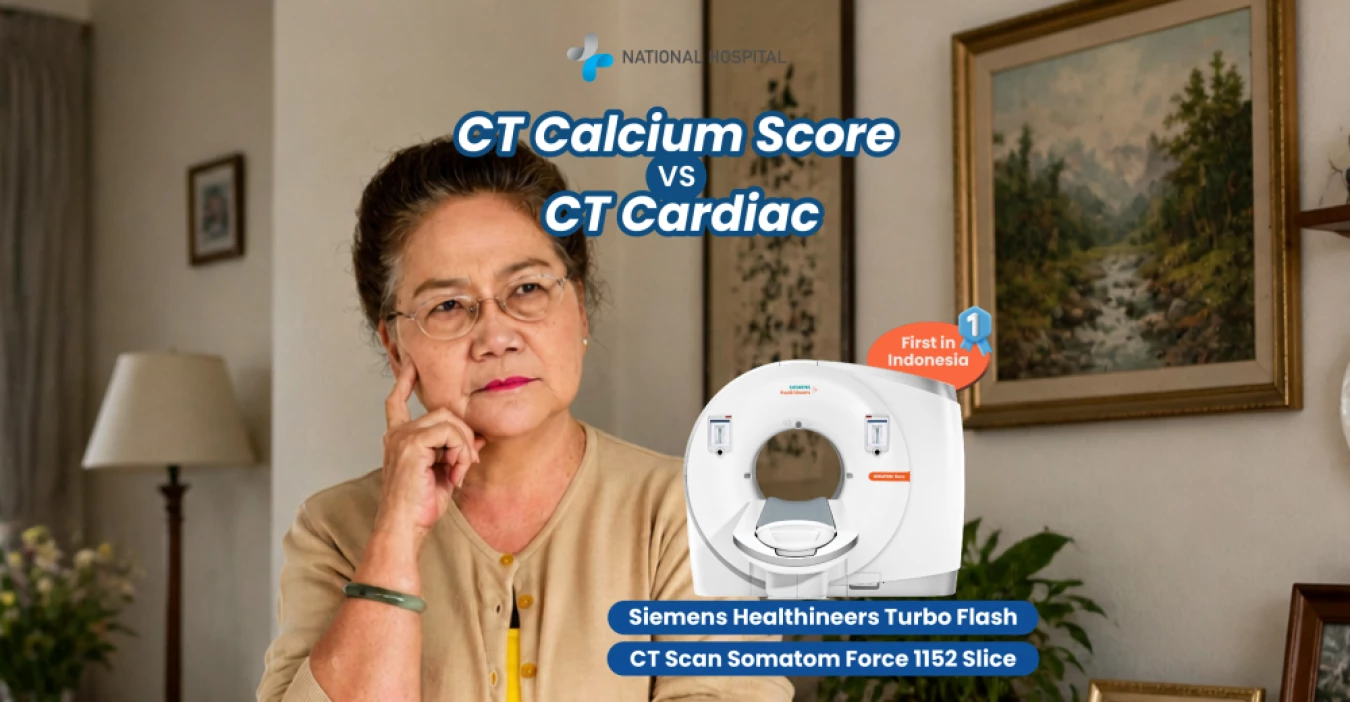
A CT scan is one of the examinations that can be used to help evaluate the condition of the heart and coronary blood vessels. In cardiac examinations, several types of CT scans may be performed depending on the purpose of the examination, including CT Calcium Score and contrast-enhanced CT Cardiac.
Although both are used to evaluate the heart, these two examinations provide different functions and information. In this regard, dr. Lenny Kartika Sari, Sp.JP, a Cardiologist and Vascular Medicine Specialist at National Hospital, provides further explanation about the differences between CT Calcium Score and contrast-enhanced CT Cardiac, as well as when each examination may be recommended. Here is the explanation!
CT Calcium Score, or Coronary Artery Calcium (CAC) Score, is an examination used to measure the amount of calcium or calcified plaque in the coronary arteries. The examination produces a calcium score.
In general, the higher the calcium score, the greater the risk that a person has coronary artery disease or significant narrowing of the coronary arteries. Therefore, CT Calcium Score plays a greater role in assessing the risk of heart disease rather than directly determining how severe the narrowing is in each coronary artery.
This examination may primarily be considered as part of screening for patients who do not have symptoms and have a low to intermediate risk, based on the doctor’s assessment. The results can help doctors determine the next steps, such as whether the patient needs cholesterol-lowering therapy, such as statins, or requires additional examinations.
Unlike CT Calcium Score, contrast-enhanced CT Cardiac is performed by administering a contrast agent through a blood vessel. The purpose is to make the structure of the coronary arteries more clearly visible. This examination allows doctors to evaluate the coronary arteries in greater detail, including:
Therefore, contrast-enhanced CT Cardiac provides more direct information about the condition of the coronary arteries and the presence of narrowing.
Simply put, the difference between the two lies in the purpose of the examination. CT Calcium Score is used to measure the amount of calcium in the coronary arteries and produces a calcium score that can help assess the risk of coronary artery disease. This examination does not require the injection of a contrast agent and is generally used to help assess risk in certain patients, particularly those who do not have symptoms.
Meanwhile, contrast-enhanced CT Cardiac involves injecting a contrast agent through a blood vessel to obtain a more detailed image of the coronary arteries. This examination can help doctors assess the condition of the blood vessels, including whether narrowing is present and how severe it is. With more comprehensive information, contrast-enhanced CT Cardiac may be used for patients with specific indications, depending on their condition and the doctor’s considerations.
In short, CT Calcium Score focuses more on risk assessment, while contrast-enhanced CT Cardiac focuses more directly on the condition of the coronary arteries.
This does not mean that one examination is better than the other. The type of examination required depends on each patient’s condition and the purpose of the examination. For patients who do not have symptoms, CT Calcium Score can help estimate the risk of coronary artery disease and determine whether preventive measures or further examinations may be needed.
Meanwhile, for patients who already have symptoms or require a more comprehensive evaluation of the coronary arteries, contrast-enhanced CT Cardiac, which may include calcium score assessment and CT coronary angiography, can provide more complete information about the condition of the blood vessels, including the presence of plaque and the degree of narrowing.
However, the decision regarding the most appropriate examination should always be based on the patient’s symptoms, risk factors, medical history, and the results of the doctor’s evaluation.
CT Calcium Score and contrast-enhanced CT Cardiac can both be used to help evaluate coronary artery disease, but they serve different purposes. CT Calcium Score helps assess risk based on the amount of calcium in the coronary arteries. Meanwhile, contrast-enhanced CT Cardiac allows doctors to examine the coronary arteries in greater detail to identify the presence of narrowing and determine its severity.
A cardiac CT scan can be an important part of assessing both cardiovascular risk and the condition of the coronary arteries. By selecting the appropriate examination according to each patient’s condition and needs, doctors can obtain more accurate information to determine the next steps in treatment and management.
National Hospital is supported by a team of experienced specialist doctors, as well as modern medical technology and facilities, including cardiac CT scan examinations equipped with advanced imaging technology. By prioritizing diagnostic accuracy and patient comfort, National Hospital is committed to providing comprehensive and trusted cardiovascular care.






 info@national-hospital.com
 Suggestion
 Login
Login