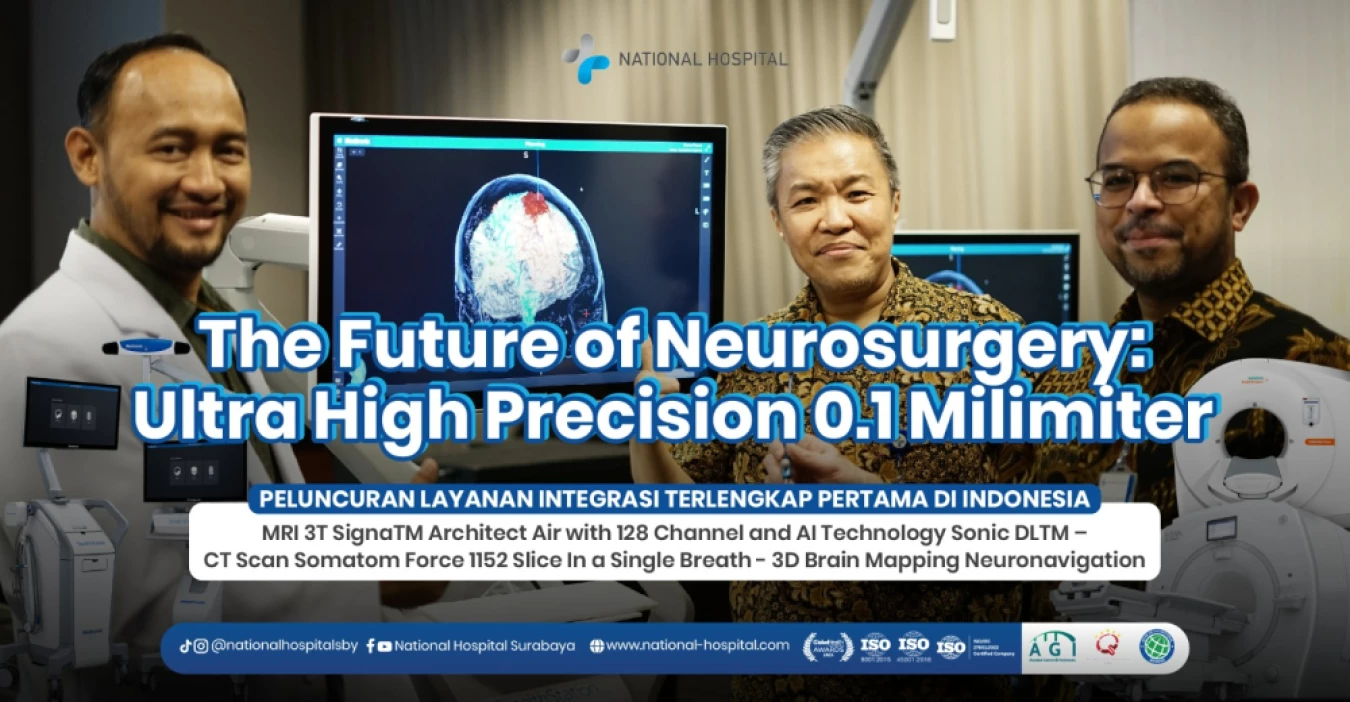
National Hospital has introduced an integrated suite of high-precision neurosurgical technologies as part of its commitment to advancing modern neurosurgical services. The introduction of these technologies further strengthens National Hospital’s position as one of Indonesia’s technologically advanced healthcare centers, reaffirming its commitment to medical innovation in support of increasingly precise patient care.
Under the theme “The Future of Neurosurgery: Ultra High Precision 0.1 Millimeter,” the launch of this facility is the result of a collaboration between National Hospital, the National Hospital Neuroscience Center (NHNC), Medtronic, GE HealthCare, Siemens Healthineers, and Elo Karsa Utama.
The technologies introduced include the 3T SIGNA™ Architect AIR™ MRI system with 128-channel technology and AI capabilities, the SOMATOM Force CT scanner capable of acquiring 1,152 slices in a single scan, as well as 3D brain mapping and neuronavigation technologies. The integration of these technologies enables more comprehensive anatomical visualization, helping physicians plan and perform neurosurgical procedures according to each patient’s clinical condition.
National Hospital CEO Ang Hoey Tiong said the investment represents a strategic step toward strengthening the hospital’s neuroscience service capabilities.
“We did not borrow this equipment; we purchased it to make our services at National Hospital faster,” he explained.
Direct ownership of this suite of technologies represents a strategic move by National Hospital to strengthen its neuroscience services while enhancing the hospital’s ability to adopt cutting-edge medical technology.
“This investment not only expands access to modern neurosurgical technology in Eastern Indonesia but also reinforces National Hospital’s role in advancing technology-driven healthcare services across Indonesia,” Ang Hoey Tiong added.
National Hospital neurosurgeon Dr. dr. Achmad Fahmi, Sp.BS(K) Subsp.N-Func, FINPS., IFAANS, explained that neuronavigation technology helps physicians identify the target location for a procedure and monitor instrument positions throughout the operation. The system can be used in various neurosurgical procedures involving both the brain and the spine.
“With this navigation system, we can identify the area of the brain we want to reach, whether to place an instrument or device, remove tissue, or perform other procedures. As the instrument moves, its position can be monitored in real time through the system,” said Dr. dr. Achmad Fahmi during the technology launch at the Ang Kang Hoo Auditorium, National Hospital Surabaya, on Thursday (October 29).
According to Dr. Fahmi, neuronavigation can achieve accuracy of less than one millimeter under appropriate conditions and for suitable procedures. This level of precision depends on the patient registration process and maintaining the head’s position during surgery. If a positional change affects the alignment between the anatomical map and the patient’s actual anatomy, the medical team must perform registration again to ensure the navigation guidance remains accurate.
Dr. dr. Achmad Fahmi emphasized that neuronavigation is not a robotic technology that replaces the physician’s role. Rather, it is a supporting system designed to improve procedural precision.
“This technology is not a robot that takes over the doctor’s work. The system helps display the instrument’s position in real time, while the doctor remains in control and performs the surgery,” he added.
Dr. Fahmi further noted that the primary benefit of this technology is not simply to shorten operating times, but to help physicians reach target locations more precisely and reduce the need to repeatedly search for the appropriate surgical pathway. Improved time efficiency may be an additional benefit, depending on the type of case and the complexity of the operation.
Meanwhile, National Hospital functional neurosurgeon dr. Heri Subianto, Sp.BS (K) Subsp.N-FUNC, FINPS, explained that advances in imaging and neuronavigation technologies also support the more integrated processing and presentation of brain anatomy data. One example is tractography, a technique used to map nerve fiber pathways in the brain, helping physicians understand the relationship between the targeted area and the surrounding neural structures.
According to dr. Heri, integrating data processing with the navigation system helps physicians access the anatomical information needed for procedural planning. This technology may also support more targeted catheter placement in selected cases, including procedures to treat intracerebral hemorrhage.
With more accurate location guidance, physicians can direct instruments toward the intended target based on imaging results and the patient’s condition. Nevertheless, the choice of technique and use of technology remain tailored to medical indications and the clinical judgment of the medical team.
Supported by a team of specialists in vascular neurosurgery, functional neurosurgery, and neuro-oncology, National Hospital continues to develop multidisciplinary services that integrate medical expertise with technological innovation, while prioritizing patient needs and safety.






 info@national-hospital.com
 Suggestion
 Login