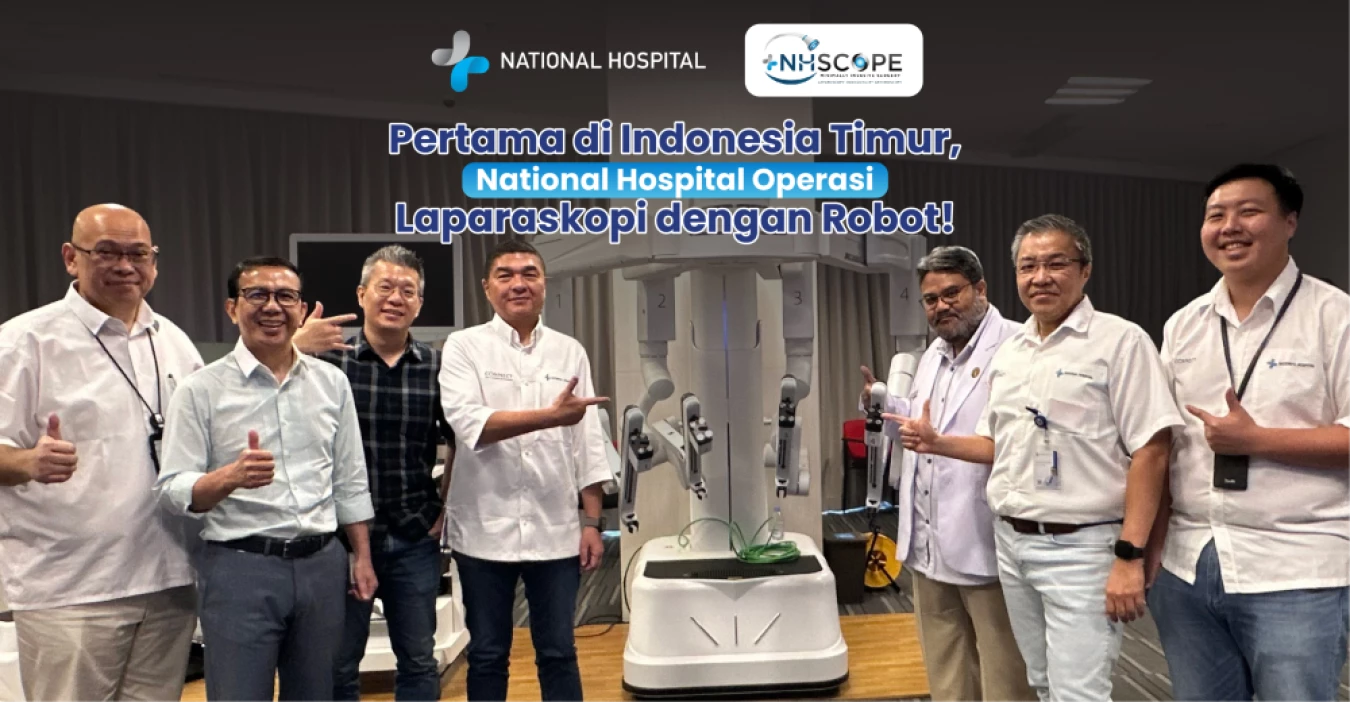
SURABAYA – The healthcare industry in Indonesia continues to grow rapidly. One of the innovations driving this progress comes from National Hospital. For the first time in Eastern Indonesia, National Hospital has performed a robot-assisted laparoscopic surgery conducted by dr. Robert Hunan Purwaka, Sp.OG, D.MAS, F.MIS.
National Hospital has introduced the Edge Medical MP1000 Multi-port Endoscopic Surgical Robot System, an advanced robotic laparoscopic system that is claimed to significantly enhance surgical precision and safety.
“Conventional laparoscopy is performed directly by hand, but now we are assisted by robotic technology. However, the robot does not operate independently. All movements are fully controlled by the doctor,” said dr. Robert Hunan Purwaka, Sp.OG, D.MAS, F.MIS at National Hospital.
Dr. Robert completed the robotic laparoscopic procedure in 100 minutes. He is a physician who has completed a fellowship in Minimally Invasive Surgery (Laparoscopy) at the KK Hospital, Singapore.
Dr. Robert explained that the robotic system consists of three main components: the surgical console, the monitor tower, and the robotic console. All three components are fully controlled by the surgeon. From the surgical console, the doctor uses a joystick to control the camera and surgical instruments operated by robotic arms.
“The doctor controls the viewing direction, instrument movements, opening, closing, rotating, and grasping of tissue through the joystick. It feels as if our hands are truly inside the patient’s body,” he explained.
In addition to obstetrics and gynecology, the robotic system introduced by National Hospital is also used in other specialties, namely digestive surgery and urology. In gynecology, robotic surgery is utilized for procedures such as hysterectomy, removal of fibroids and cysts, as well as complex adhesion cases.
Meanwhile, in digestive surgery, robotic technology supports complex procedures involving appendicitis, gallstones, liver, pancreas, and gastric resections. In the field of urology, it is used for procedures such as prostate and kidney surgery.
Dr. Robert added that the primary advantages of this robotic system lie in its high precision and instrument flexibility, which surpass conventional laparoscopy. Robotic surgery can reduce the risk of bleeding and complications, better preserve healthy tissue, and enable faster patient recovery. Additionally, complex surgeries that typically take 8–10 hours can be shortened by approximately 50 percent.
CEO of National Hospital, Ang Hoey Tiong, stated that the hospital continuously brings world-class services and technology as part of National Hospital’s vision to deliver international-standard healthcare services in Indonesia.
“This technology enables an exceptionally high level of precision, minimal incisions, optimal accuracy, and faster and safer patient recovery. Ultimately, what we deliver is not merely advanced technology, but a better quality of life for patients,” he concluded.






 info@national-hospital.com
 Suggestion
 Login
Login