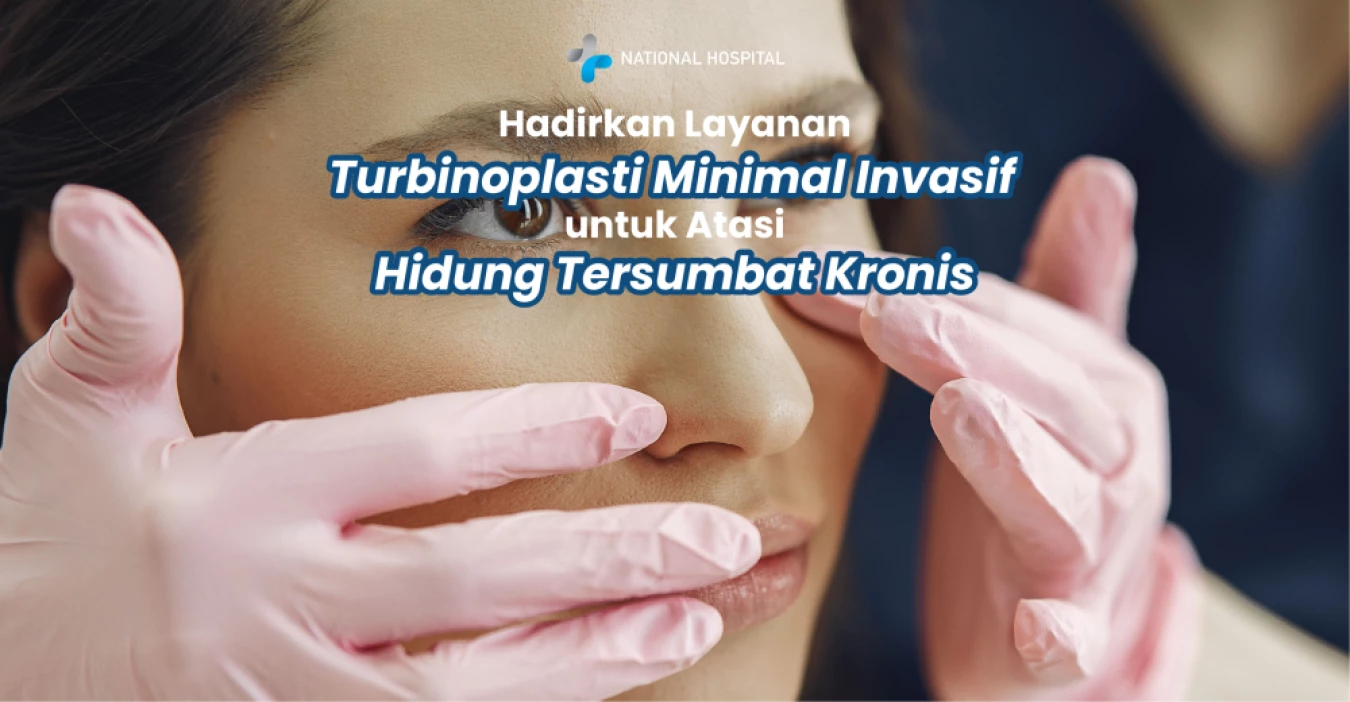
Nasal congestion that persists for a long time is often considered a mild complaint caused by a cold or allergies. In fact, this condition can affect quality of life, ranging from difficulty breathing, sleep disturbances, decreased concentration, to reduced daily productivity.
Although often considered a mild complaint, prolonged nasal congestion can be a sign of inferior turbinate hypertrophy, which is an enlargement of the turbinate tissue inside the nose that causes the airway to narrow. When medication no longer provides optimal results, surgery may be an option to restore respiratory function.
As a hospital that provides ENT services supported by modern technology and experienced medical professionals, National Hospital offers Endoscopic Turbinoplasty, a minimally invasive procedure to treat nasal congestion caused by inferior turbinate hypertrophy.
According to National Hospital's ENT Consultant in Rhinology, dr. Budi Sutikno, Sp.THTBKL, Subsp. Rino. (K), Endoscopic Turbinoplasty aims to improve nasal congestion by reducing the size of enlarged inferior turbinates, thereby creating a more open airway.
"We perform Endoscopic Turbinoplasty on both the right and left sides. The main purpose of this procedure is to improve nasal congestion caused by inferior turbinate hypertrophy. By reducing the size of the enlarged turbinates, the airway becomes more open, allowing patients to breathe more comfortably," explained dr. Budi Sutikno.
One of the advantages of this procedure is the use of endoscopic techniques, which allow doctors to clearly and comprehensively visualize the surgical field, from the front to the back of the nasal cavity. More detailed visualization enables greater precision while helping preserve tissue that is still functioning properly.
"Because it is performed endoscopically, visualization of the surgical field is excellent. We can control the procedure more accurately, including determining how much turbinate tissue needs to be reduced. This makes the procedure more measured while minimizing trauma to the surrounding tissue," he added.
In addition to being more precise, Endoscopic Turbinoplasty also has a relatively short procedure time. Surgery on both sides of the nose is generally completed within approximately 20–30 minutes, with very minimal blood loss, at around 10 cc.
Another advantage is a more comfortable recovery process. Patients can generally go home the day after surgery and only need simple home care using a nasal spray containing saline solution, without requiring antibiotics or oral pain medication.
"After surgery, patients only need to use a nasal spray containing saline or salt solution to help with the healing process. In general, antibiotics or oral pain relievers are not required," said dr. Budi.
During the recovery period, patients usually undergo two follow-up visits, namely in the first and third weeks after surgery. During these visits, the doctor will clean crusts or blood clots mixed with mucus that form during the healing process so that the nasal cavity remains clean and the surgical results can be optimized.
Based on the experience of patients who have undergone this procedure, postoperative pain is also considered very mild. "Most patients describe the pain as only being on a scale of 1 to 2 out of 10, so the recovery process is generally comfortable," concluded dr. Budi Sutikno.
With a minimally invasive endoscopic technique, a short operating time, minimal bleeding, and a relatively fast recovery period, Endoscopic Turbinoplasty at National Hospital is one of the effective treatment options for patients with chronic nasal congestion caused by inferior turbinate hypertrophy. Through this service, patients are expected to breathe more freely, sleep better, and carry out their daily activities more comfortably.





 info@national-hospital.com
 Suggestion
 Login
Login